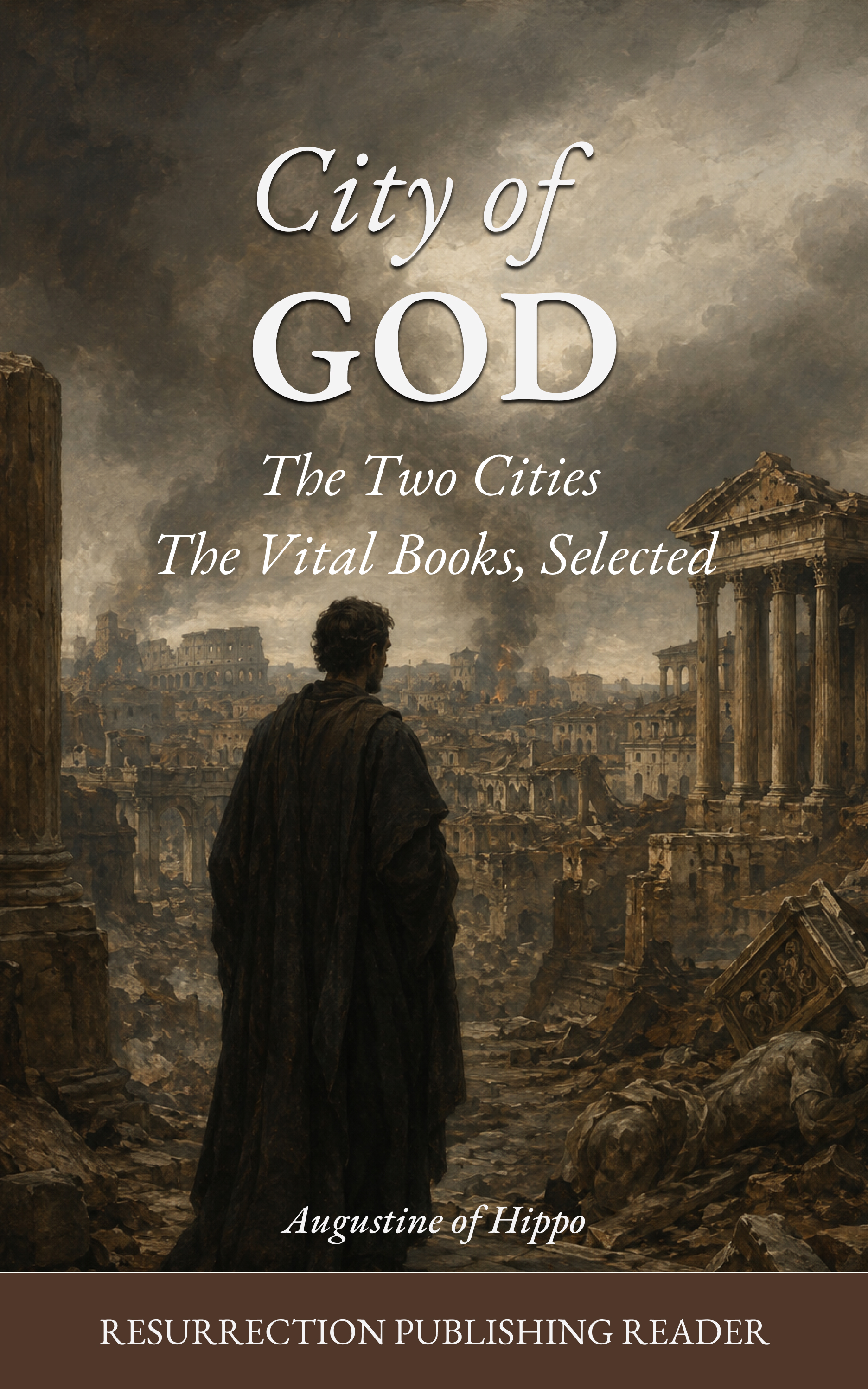
Cover of The City of God — a cloaked figure overlooking burning, ruined Rome under a storm-darkened sky
Kindle edition · on Amazon

The City of God

The Two Cities — The Vital Books, Selected

Augustine of Hippo

Patristic (West)

  • Question: What are the two cities — and why is modern thought still arguing with Augustine’s answer?
  • Composed: 413–426 · Translated: 1887, the Dods edition
  • Official publication: September 23, 2026
  • Kindle edition: on Amazon
  • Contents: 11 whole books of the 22 — I, IV, V, X, XI, XII, XIV, XIX, XX, XXI, XXII — 332 chapters, never fragments

Augustine began The City of God after Alaric’s Goths sacked Rome in 410, when pagans blamed the neglect of the old gods for the disaster — and he spent the next thirteen years writing his answer: two loves built two cities, and the story of Rome belongs to a longer story than one army at one gate. This reader prints eleven of the twenty-two books whole — the books where the argument is made — each with a one-page opener and an argument trace that ends in the modern debates, with bridge summaries carrying the reader across the books not printed, so the arc never goes dark.

Kindle edition — on Amazon

Kindle edition — on Amazon

Kindle edition sold by Amazon. The editorial apparatus — the Publisher’s Preface, the openers, the argument traces, the bridge summaries, the glossary, and the indexes — was generated with large language models under the Resurrection Publishing editorial method; every quotation was verified word for word against the source editions, and no page reached print until a human editor accepted it.

About this edition

Eleven whole books of Augustine’s The City of God — Books I, IV, V, X, XI, XII, XIV, XIX, XX, XXI, and XXII — every book complete, 332 chapters, never fragments. The selection and arrangement of the eleven books is this edition’s own. Each book arrives in three pieces: a one-page opener, the complete book, and an argument trace that follows the reasoning and ends by following it into the modern debates. The four stretches between the printed books are summarized inside those traces, so the argument runs unbroken from the ruins of Rome to the eternal Sabbath. The translation is the 1887 Dods edition, printed whole, in the public domain; the chapter notes are that edition’s own, set at the places in the text they were written for.

The editorial layer — the prefaces, the openers, the traces, the bridge summaries, the appendix, the glossary, and the indexes — was generated with large language models working under the Resurrection Publishing editorial method, then verified quotation by quotation against the source editions. No page reached print until a human editor accepted it.

Written 413–426 · 1887 translation · 11 whole books of 22 · 1 question: what holds a society together, and what is a society finally for?